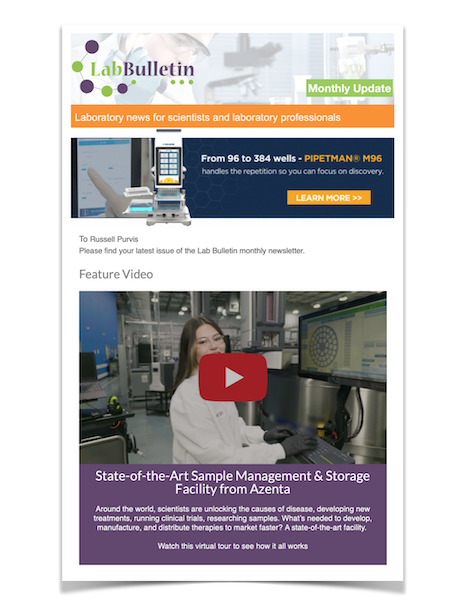
SP Scientific announces the introduction of the LyoModelling Calculator (LMC) - a powerful new software utility that enables those developing freeze drying cycles to calculate the time required for primary drying and the maximum product temperature based on user data input.
This free software resource is available on the SP Scientific website**. Users obtain a starting point for primary drying duration and the maximum product temperature at the sublimation interface using pertinent information, such as shelf temperature and chamber pressure, from which an optimized freeze-drying cycle can be developed. The LMC is based on the steady-state heat and mass transfer model of primary drying developed by...
In-depth profiling of IgG glycosylation coupled with ADCC assays enables generation of robust biosimilar comparability data
Sartorius Stedim Biotech (SSB), a leading international supplier for the biopharmaceutical industry, announced the launched of a new Released N-Glycan Assay for the in-depth profiling of IgG glycosylation. This new physico-chemical assay, developed by SSB’s subsidiary BioOutsource and offered in combination with its unique Antibody Dependent Cell Cytotoxicity (ADCC) assay platform, combines data on the molecular structure...
New worldwide, exclusive license agreement provides broad access to institut Pasteur's virus vector technology - Zika vaccine development progressing with high priority.
Themis successfully extended its existing license agreement with Institut Pasteur, France, which grants the company a broad access to a well-established virus vaccine vector technology. The safety and tolerability profile of the vector was already proven in a Phase I trial when the two partners used the technology platform for the development of a first in class Chikungunya vaccine...
Today Lonza announced the release of a new e-Learning Module for its QC Insider™ Toolbox, “Overcoming Interference,” which covers the causes of interference in the Bacterial Endotoxins Test (BET) and provides the user with solutions to help ensure compliance.
Being able to overcome the inhibitory or enhancing properties of a sample is required by the BET monograph, the validation of which forms part of the test for the final product release of injectable drugs and medical devices. Many of the pharmaceutical products that are either in use or being developed today have characteristics that cause them to interfere with the BET....
ISG has been awarded a £21 million technical fit out project by HSL (Health Services Laboratories) to create its new London core laboratory; a facility that will include state-of-the-art pathology laboratories serving the London health community, as well as HSL’s corporate offices.
HSL is a joint venture between The Doctors Laboratory (TDL), University College London Hospitals NHS Foundation Trust, and the Royal Free London NHS Foundation Trust. The new 133,000 sq ft laboratory in the ‘Halo’ building at One Mabledon Place, in the epicentre of the emerging biosciences corridor in Kings Cross, will see the organisation consolidate existing disparate pathology facilities from North Central London into what will become one of the largest pathology laboratories in Europe.
Avacta Group plc and Glythera Limited announce that they have established a collaboration to evaluate the use of Glythera’s PermaLink™ conjugation chemistry in combination with Avacta’s Affimer technology with the aim of developing a new class of highly targeted bio-therapeutics as a superior alternative to the established class of antibody drug conjugates (ADCs).
ADCs use an antibody to which a toxin/chemotherapy payload is chemically attached for targeted delivery to a tumour. Over 50 ADCs are currently in clinical development; of these, approximately a quarter are in Phase II or Phase III. The market is estimated to be worth around $1bn today from two approved compounds and is expected to be worth $10bn annually by 2024.
A celebratory topping-out ceremony has taken place for the new University of Glasgow £16m Imaging Centre of Excellence (ICE) building on the grounds of the Queen Elizabeth University Hospital.
This ground-breaking new centre, supported by the NHS and funded by the UK Government and the Medical Research Council (MRC) as part of the Glasgow City Region City Deal, will provide world-leading clinical research facilities and provide a hub for academic, scientific and NHS clinical expertise into brain imaging in diseases such as stroke, dementia and brain tumours....
A new streamlined approach to genetic testing for women with ovarian cancer provides testing rapidly and affordably, allowing many more patients to benefit from personalised cancer management and their relatives to benefit from cancer prevention strategies.
The new approach offers cancer patients the opportunity to get gene testing at one of their routine cancer clinic appointments instead of having to be referred to a separate genetic testing clinic. As well as offering a more streamlined patient journey, the pathway is less resource intensive for health systems and could save the NHS millions of pounds per year, if implemented nationally....
The Postnova TF2000 is an advanced thermal field flow fractionation (TF3) system that provides a highly efficient method of separating and characterising complex polymer samples such as natural or synthetic rubbers, starches and paints from approximately 10 kDa up to 100 MDa and more in organic and aqueous solvents.
The TF2000 uses a temperature gradient as the driving force for its separation of polymers and particles. Molecules affected by the thermal gradient undergo diffusion which enables separation by both their molar mass and chemical composition. This unique feature allows the separation of different materials having the same molar mass....
Scientists from the University of Glasgow have concluded that focusing health messages on sugar in isolation may mislead consumers on the need to also reduce overall calories, including those from fat.
The research, published today in the International Journal of Epidemiology, looked at data from 132,479 people from across the UK, who completed online diet questionnaires as well as having their measurements taken at a clinic....
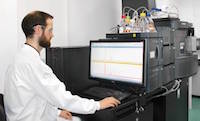
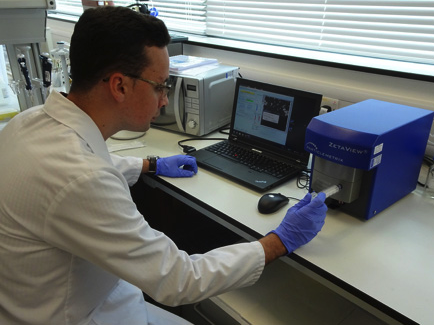
Particle Metrix, developers of versatile particle characterization solutions for the life sciences, report on how Cell Guidance Systems use the ZetaView® particle characterization system for exosome research and quality control.
Cell Guidance Systems (CellGS) provides innovative life science research tools and services. Their goal is to identify valuable innovations from research groups around the world and develop products that address unmet needs, providing new tools that expand the possibilities of life science research....
The grant will fund research led by scientist who broke his neck aged 18
The Masonic Charitable Foundation has awarded £65,000 to the INSPIRE Foundation to fund a research project which aims to improve the quality of life and independence of people with spinal cord injuries. The research project will be led by young research scientist Sean Doherty who broke his neck in a mountain bike accident in 2008 at the London Spinal Cord Injury Centre based at the Royal National Orthopaedic Hospital in Stanmore. Sean broke his neck in...
Emprove® risk assessment program provides easy access to information on materials used for drug product manufacturing
Merck has expanded its industry-leading Emprove® risk assessment program to include a selection of products for filtration and single-use processing. The program provides documentation and regulatory information on materials used in the manufacture of drug products.....
Program aims to improve access to cancer care in Africa and increase number of oncologists on the continent - Paediatric and adult medical fellowship planned for African doctors in India
Merck, a leading science and technology company, today announced to start the first Merck Africa Medical Oncology Fellowship Program for Sub-Saharan African countries in partnership with University of Nairobi, Kenya. The program will be conducted at University of Nairobi and is part of Merck’s efforts to improve access to cancer care and strengthen the healthcare system in emerging markets....
Brigitte Fernandes-McAlear, Director, Roche Molecular Solutions said “This is truly exciting news and will transform cervical cancer testing, saving many more lives.
“DNA based HPV testing has been at the heart of our research for over 10 years. Through our landmark ATHENA study Roche Diagnostics not only validated the cobas HPV test, but also demonstrated the long-term safety of using HPV DNA as a predictor of cervical cancer risk. “To see HPV primary screening given prominence alongside existing testing, is therefore a landmark moment for patients. We look forward to...
Postnova Analytics reports on exciting advances in the analysis of plasma proteins using a hyphenated system that couples asymmetric flow Field-Flow Fractionation (AF4) and inductively coupled plasma-mass spectrometry (ICP-MS).
In a new application study researchers show how an AF4-ICP-MS system is able to obtain valuable information on the multi-element speciation and absolute molecular mass of human plasma proteins such as Albumin and Transferrin. Human Serum Albumin (HSA) and Transferrin are the two main plasma proteins that are known to bind and transfer metal ions in biological fluids....
Quorum Technologies report on the use of their PP3000T cryo preparation system in conjunction with the new beamline at Diamond Light Source to help align protein crystals prior to X-ray macromolecular crystallography experiments.
Dr Anna Warren is a Senior Support Scientist on VMXm, a new beamline currently under development and construction at Diamond Light Source where it will be used to carry out X-ray macromolecular crystallography experiments. Diamond offers 26 separate beamlines to aid with research groups in the UK and abroad, allowing them to determine the three dimensional structure of matter, such as protein molecules...
Researchers have identified eight new genetic variations in the human genome that could be linked to an increased risk of developing myeloma.
The findings provide additional evidence, and build on existing research that suggests myeloma can run in families. In the largest study of its kind, scientists at The Institute of Cancer Research, London, compared the genomes of myeloma patients with those of healthy individuals....
Bruker announces a new, more comprehensive, more efficient and easy-to-use profiling module for detailed lipoprotein subclass analysis using Nuclear Magnetic Resonance (NMR).
Lipoproteins are key in assessing the risk of cardiovascular disease (CVD). In recent years, it has become clear that efficient and fast methods for analyzing the very important lipoprotein subclasses provide further insights into CVD. Current methods are time-consuming and costly, and do not provide sufficiently detailed insights for deeper clinical research into the diagnosis, prognosis and prevention of CVD....
EM Resolutions, manufacturers and suppliers of tools and accessories for users of electron microscopes, report on the use of their support films in use at the Cambridge Advanced Imaging Centre.
CAIC, the Cambridge Advanced Imaging Centre is a core resource in advanced light and electron microscopy for the School of Biological Sciences in the University of Cambridge. It has some 200 registered users and around 75 of those are electron microscopists....
Magritek reports on the benefits of their Spinsolve Benchtop NMR spectrometer for teaching practical organic chemistry to undergraduate students at Cleveland State University in Ohio.
As an urban public university, Cleveland State has a dual mission to both serve the community and to contribute to the city's redevelopment in ways that many institutions cannot. By bringing a high level of engagement to our education, Cleveland State is developing into one of the best urban universities in the nation...
Researchers from KU Leuven (Belgium), the University of Strasbourg, and CNRS have discovered a new phosphor that could make next-generation fluorescent and LED lighting even cheaper and more efficient.
The team used highly luminescent clusters of silver atoms and the porous framework of minerals known as zeolites. Silver clusters consist of just a few silver atoms and have remarkable optical properties. However, current applications are limited, because the clusters tend to aggregate into larger particles, thus losing the interesting optical properties. Professor Hofkens and his team from the Molecular Imaging and Photonics...

 This free software resource is available on the SP Scientific website**. Users obtain a starting point for primary drying duration and the maximum product temperature at the sublimation interface using pertinent information, such as shelf temperature and chamber pressure, from which an optimized freeze-drying cycle can be developed. The LMC is based on the steady-state heat and mass transfer model of primary drying developed by...
 Sartorius Stedim Biotech (SSB), a leading international supplier for the biopharmaceutical industry, announced the launched of a new Released N-Glycan Assay for the in-depth profiling of IgG glycosylation. This new physico-chemical assay, developed by SSB’s subsidiary BioOutsource and offered in combination with its unique Antibody Dependent Cell Cytotoxicity (ADCC) assay platform, combines data on the molecular structure...
 Themis successfully extended its existing license agreement with Institut Pasteur, France, which grants the company a broad access to a well-established virus vaccine vector technology. The safety and tolerability profile of the vector was already proven in a Phase I trial when the two partners used the technology platform for the development of a first in class Chikungunya vaccine...
 Being able to overcome the inhibitory or enhancing properties of a sample is required by the BET monograph, the validation of which forms part of the test for the final product release of injectable drugs and medical devices. Many of the pharmaceutical products that are either in use or being developed today have characteristics that cause them to interfere with the BET....

 This ground-breaking new centre, supported by the NHS and funded by the UK Government and the Medical Research Council (MRC) as part of the Glasgow City Region City Deal, will provide world-leading clinical research facilities and provide a hub for academic, scientific and NHS clinical expertise into brain imaging in diseases such as stroke, dementia and brain tumours....
 The new approach offers cancer patients the opportunity to get gene testing at one of their routine cancer clinic appointments instead of having to be referred to a separate genetic testing clinic. As well as offering a more streamlined patient journey, the pathway is less resource intensive for health systems and could save the NHS millions of pounds per year, if implemented nationally....
 The TF2000 uses a temperature gradient as the driving force for its separation of polymers and particles. Molecules affected by the thermal gradient undergo diffusion which enables separation by both their molar mass and chemical composition. This unique feature allows the separation of different materials having the same molar mass....
 Cell Guidance Systems (CellGS) provides innovative life science research tools and services. Their goal is to identify valuable innovations from research groups around the world and develop products that address unmet needs, providing new tools that expand the possibilities of life science research....
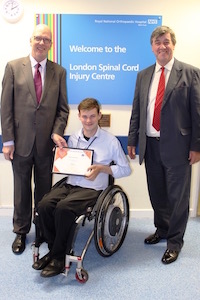 The Masonic Charitable Foundation has awarded £65,000 to the INSPIRE Foundation to fund a research project which aims to improve the quality of life and independence of people with spinal cord injuries. The research project will be led by young research scientist Sean Doherty who broke his neck in a mountain bike accident in 2008 at the London Spinal Cord Injury Centre based at the Royal National Orthopaedic Hospital in Stanmore. Sean broke his neck in...
 Merck has expanded its industry-leading Emprove® risk assessment program to include a selection of products for filtration and single-use processing. The program provides documentation and regulatory information on materials used in the manufacture of drug products.....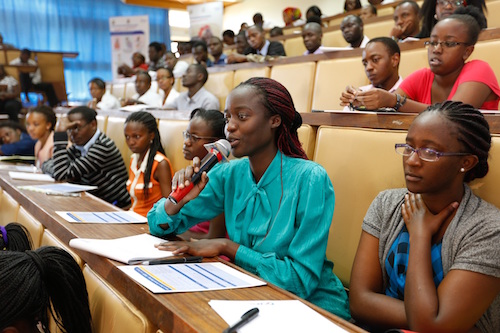
 “DNA based HPV testing has been at the heart of our research for over 10 years. Through our landmark ATHENA study Roche Diagnostics not only validated the cobas HPV test, but also demonstrated the long-term safety of using HPV DNA as a predictor of cervical cancer risk. “To see HPV primary screening given prominence alongside existing testing, is therefore a landmark moment for patients. We look forward to...
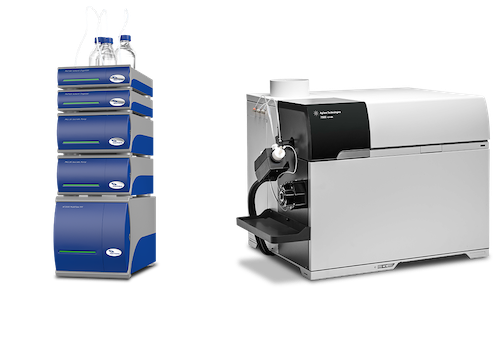 In a new application study researchers show how an AF4-ICP-MS system is able to obtain valuable information on the multi-element speciation and absolute molecular mass of human plasma proteins such as Albumin and Transferrin. Human Serum Albumin (HSA) and Transferrin are the two main plasma proteins that are known to bind and transfer metal ions in biological fluids....
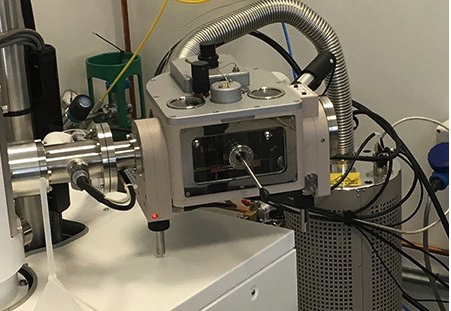 Dr Anna Warren is a Senior Support Scientist on VMXm, a new beamline currently under development and construction at Diamond Light Source where it will be used to carry out X-ray macromolecular crystallography experiments. Diamond offers 26 separate beamlines to aid with research groups in the UK and abroad, allowing them to determine the three dimensional structure of matter, such as protein molecules...
 The findings provide additional evidence, and build on existing research that suggests myeloma can run in families. In the largest study of its kind, scientists at The Institute of Cancer Research, London, compared the genomes of myeloma patients with those of healthy individuals....
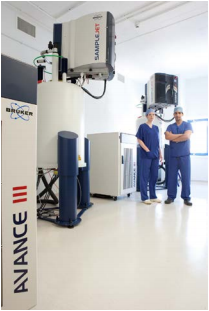 Lipoproteins are key in assessing the risk of cardiovascular disease (CVD). In recent years, it has become clear that efficient and fast methods for analyzing the very important lipoprotein subclasses provide further insights into CVD. Current methods are time-consuming and costly, and do not provide sufficiently detailed insights for deeper clinical research into the diagnosis, prognosis and prevention of CVD....
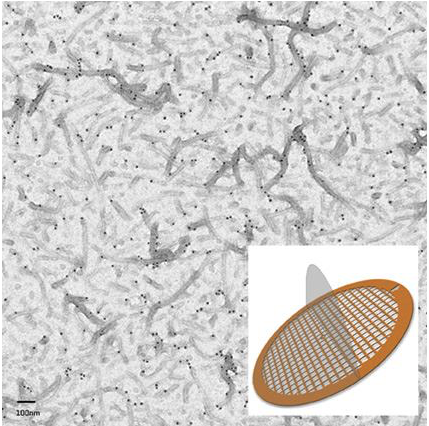 CAIC, the Cambridge Advanced Imaging Centre is a core resource in advanced light and electron microscopy for the School of Biological Sciences in the University of Cambridge. It has some 200 registered users and around 75 of those are electron microscopists....
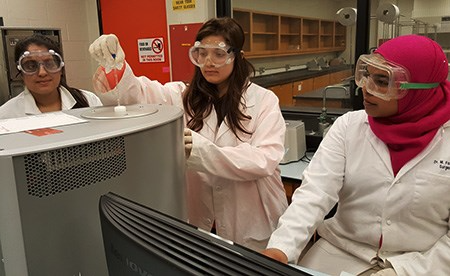 As an urban public university, Cleveland State has a dual mission to both serve the community and to contribute to the city's redevelopment in ways that many institutions cannot. By bringing a high level of engagement to our education, Cleveland State is developing into one of the best urban universities in the nation...
 The team used highly luminescent clusters of silver atoms and the porous framework of minerals known as zeolites. Silver clusters consist of just a few silver atoms and have remarkable optical properties. However, current applications are limited, because the clusters tend to aggregate into larger particles, thus losing the interesting optical properties. Professor Hofkens and his team from the Molecular Imaging and Photonics...